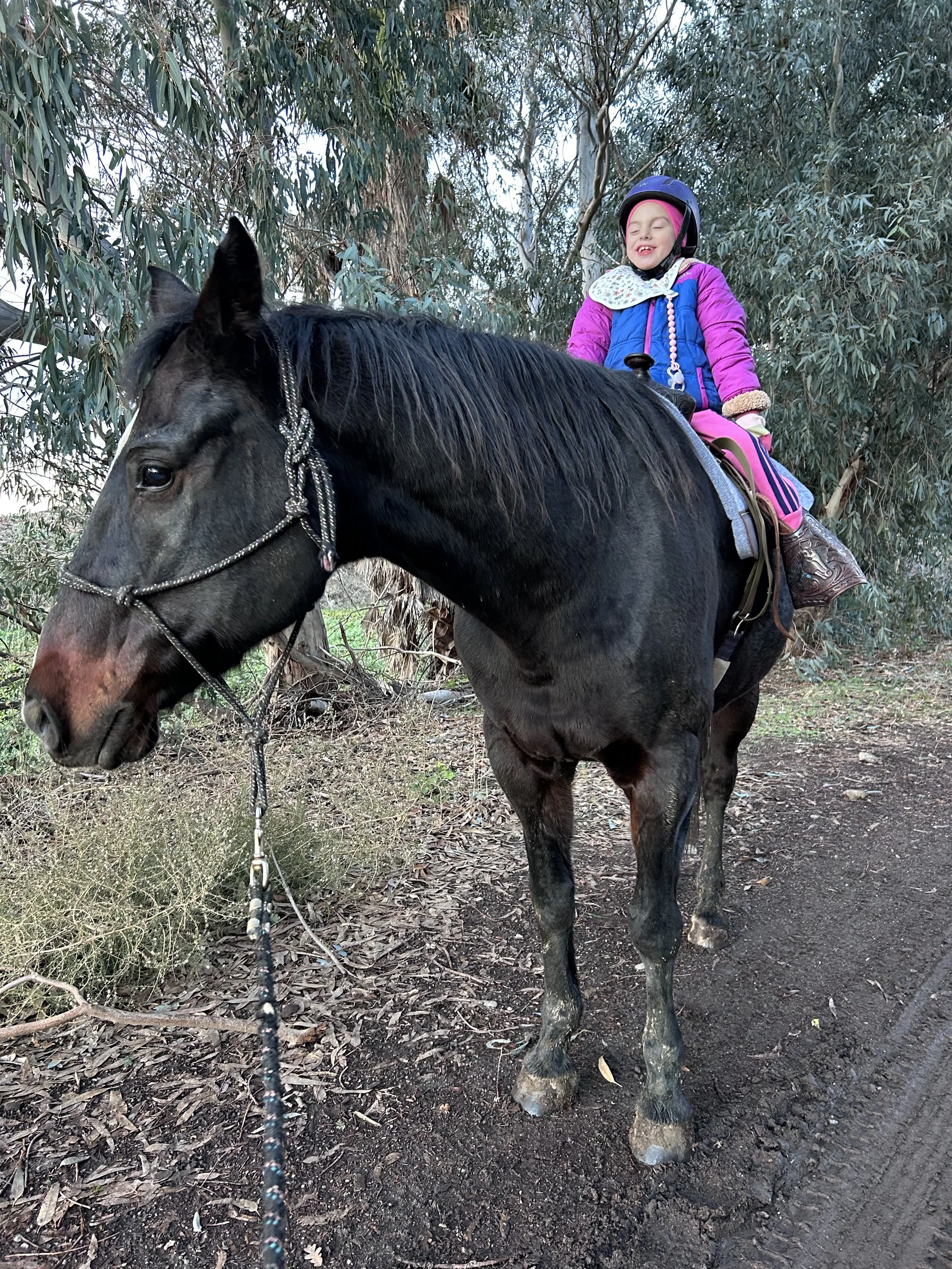
Adaptive Riding: More Than a Riding Lesson
Discover how adaptive riding at Equiroots goes beyond horseback riding. Our individualized program offers children and adults with disabilities opportunities to develop confidence, communication, independence, and everyday life skills through meaningful experiences with horses.
Building confidence, independence, and meaningful connections through horses in Tracy, California.
Sometimes, it's remembering how to brush a horse. Sometimes, it's following an instruction independently or communicating a choice without words.
And sometimes, it's simply the joy of picking a leaf from a tree while sitting on a horse.
At Equiroots, these little moments matter.
Our Adaptive Riding and Horsemanship Program offers children, teenagers, and adults with disabilities the opportunity to experience horses, develop new skills, and enjoy meaningful recreation in a supportive ranch environment.
It's about so much more than horseback riding.
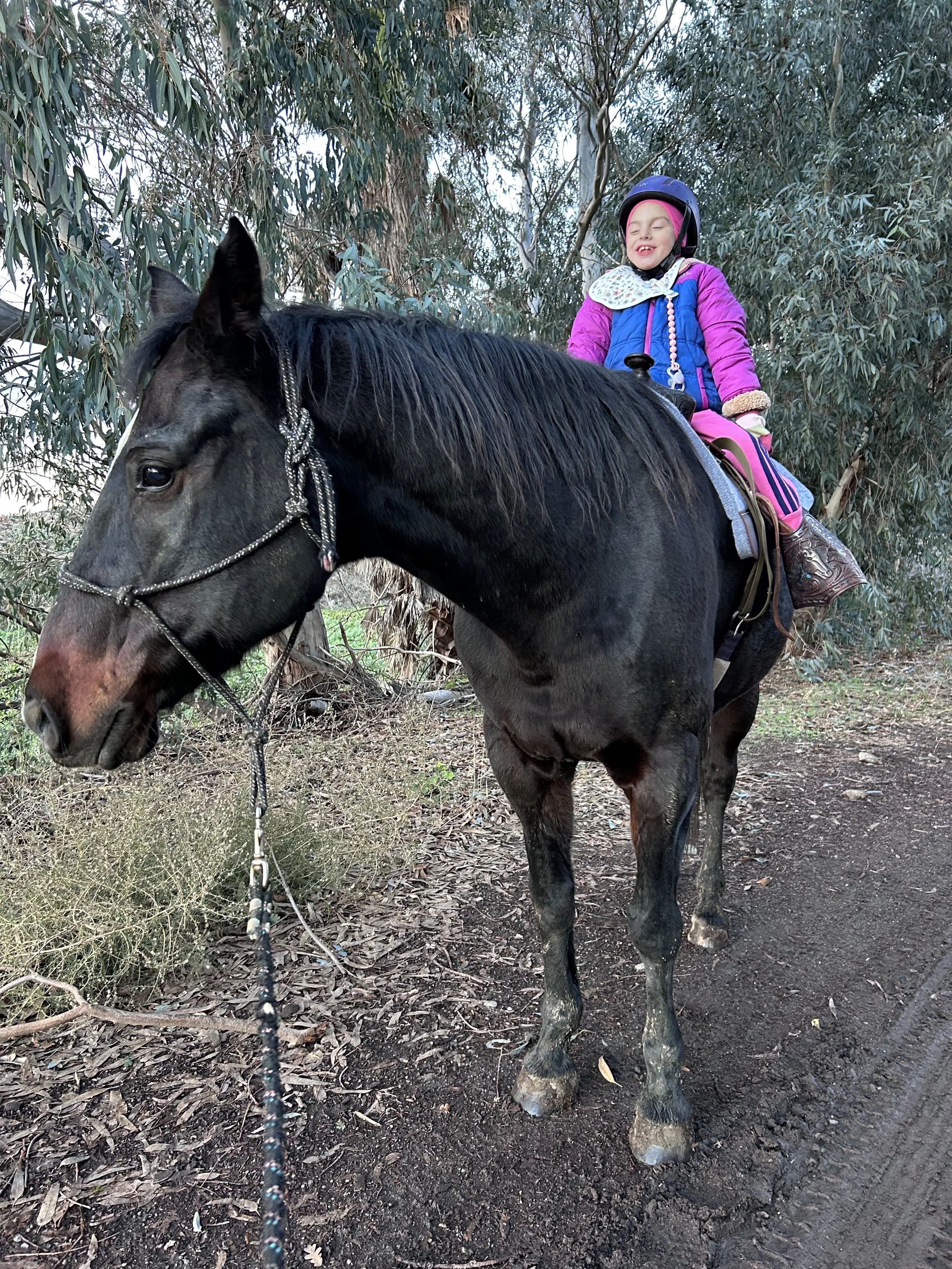
What Is Adaptive Riding?
Adaptive riding, also known as therapeutic horseback riding, makes horseback riding and horsemanship more accessible to individuals with disabilities and additional support needs.
At Equiroots, no two sessions are exactly alike. We adapt our activities, instructions, and level of support to each participant's abilities, interests, and individual goals.
We welcome inquiries from individuals with autism, Down syndrome, Rett syndrome, Pitt-Hopkins syndrome, intellectual and developmental disabilities, and other support needs.
Whether someone communicates verbally or non-verbally, needs additional processing time, or experiences physical or sensory challenges, we explore how they can participate safely and meaningfully.
We focus on the person, not just the diagnosis.
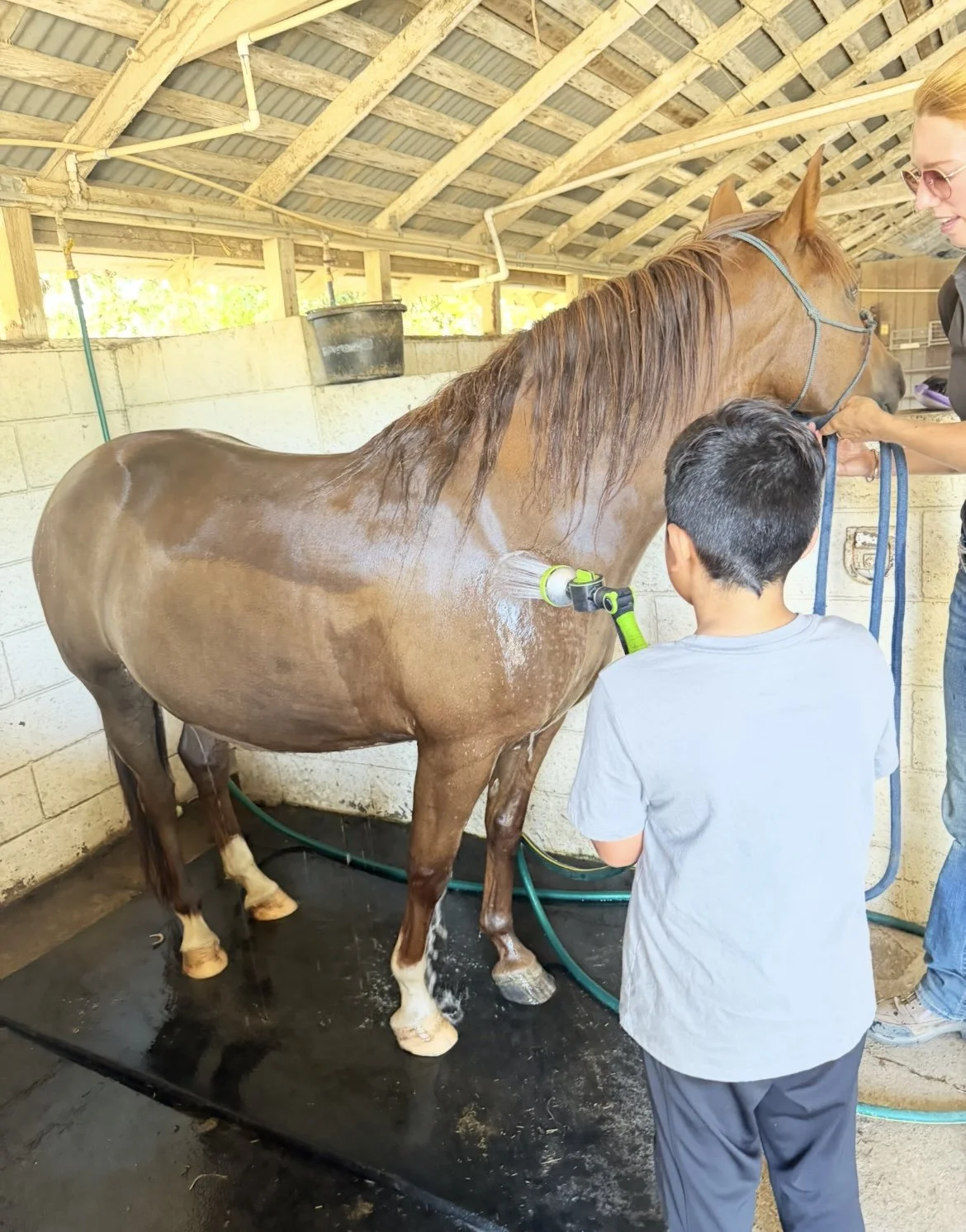
Helping Bathing a horse
Learning Through Horses
Working with horses creates natural opportunities to practice skills that are part of everyday life.
Imagine being asked to find a brush, groom a horse, and return the brush to its designated place. This simple activity involves following instructions, remembering a sequence, maintaining attention, coordinating movements, and completing a task.
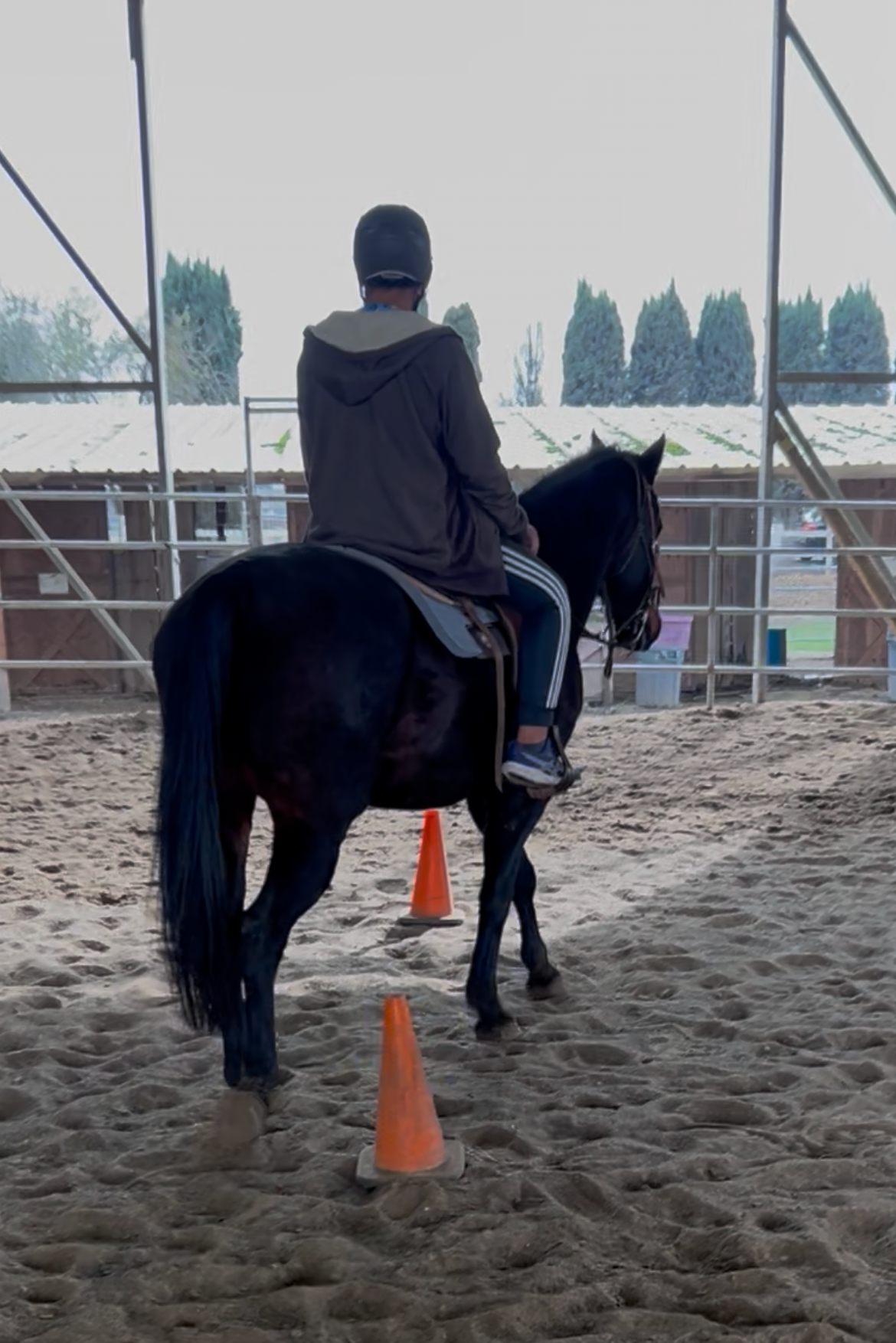
During a riding lesson, a participant might practice stopping at a cone, identifying colors, changing direction, or remembering the next step in an obstacle course.
Through these activities, participants have opportunities to practice:
Following single-step and multi-step instructions
Concentration, memory, and problem-solving
Communication and decision-making
Balance, coordination, and motor planning
Patience and emotional awareness
Independence and responsibility
Because these activities have a meaningful purpose, learning becomes part of an enjoyable experience rather than a separate exercise.
Instructions can be adapted using demonstrations, visual cues, gestures, repetition, and additional processing time.
The goal is not simply to follow directions, but to develop understanding, confidence, and active participation.
Communication Beyond Words
Not everyone communicates through spoken language. And horses don't need words to communicate either.
A participant might indicate which grooming brush they prefer by looking at it, use a gesture to express a choice, or use a communication device to indicate that they would like to continue an activity.
We recognize and respect these different forms of communication.
Working with horses also encourages participants to observe body language, recognize boundaries, express their needs, and become more aware of their surroundings.
Having limited speech does not mean having limited understanding.
Finding Calm Through Sensory Experiences
The warmth of a horse, the softness of its coat, the rhythm of its breathing, and the natural surroundings of a ranch offer a variety of sensory experiences.
During our sessions, we have seen how meaningful these simple experiences can be.
One participant became noticeably calmer while feeling water flow over his hands and gently touching a horse. Another finds comfort in quietly connecting with a horse and feeling the rhythm of its breathing.
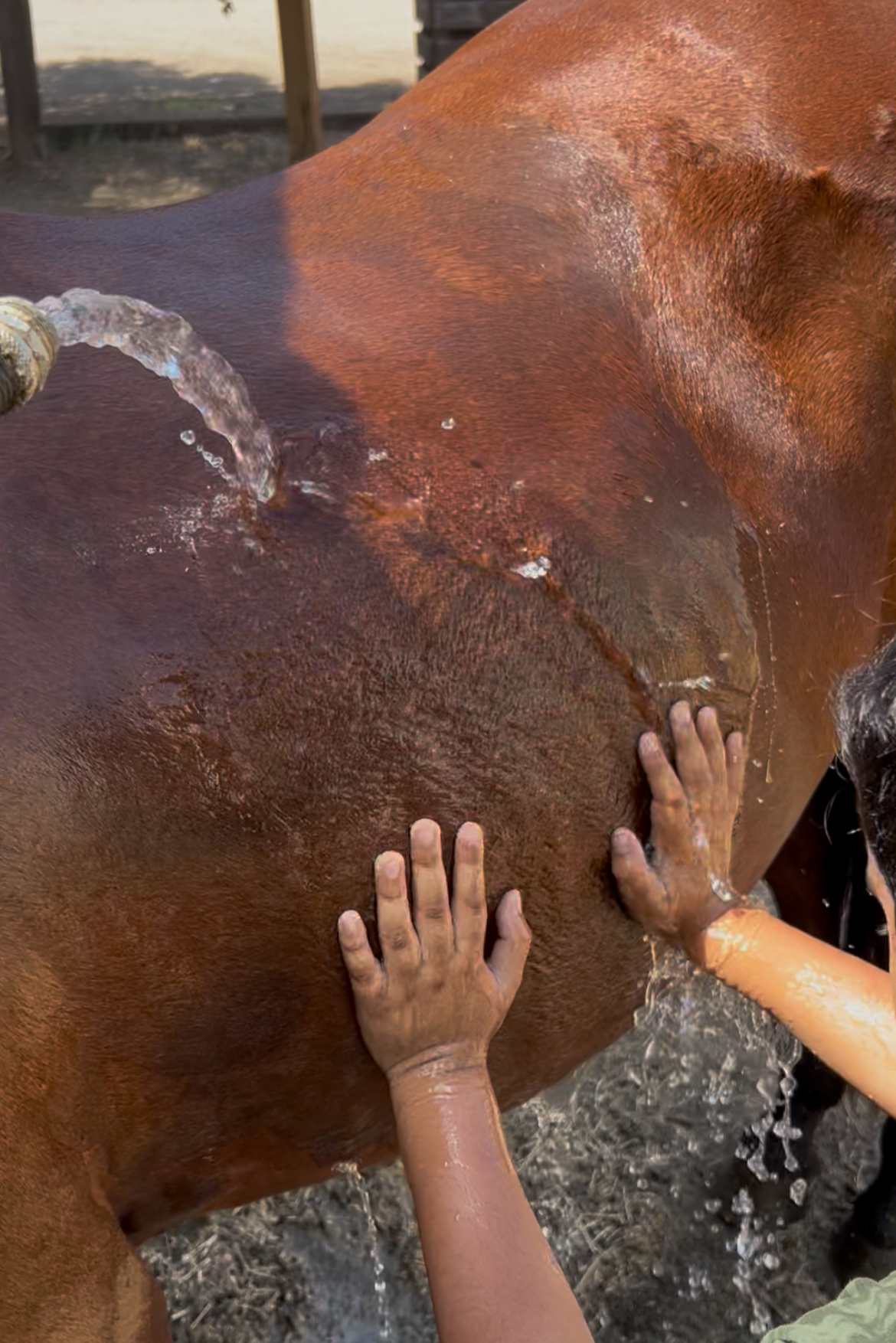
These moments remind us that meaningful experiences do not always require an instruction, a task, or a specific achievement.
For some individuals, sensory experiences can offer opportunities to relax, become more present, and explore what helps them feel comfortable.
Every participant responds differently to sensory input. By observing their responses and respecting their preferences, we can adapt activities to support their individual comfort and emotional wellbeing.
Sometimes, the most valuable thing we can do is slow down and simply be with the horse.
Beyond the Saddle
Does someone need to ride a horse to benefit from our program? Absolutely not.
Grooming, leading, observing, and caring for horses are all meaningful parts of horsemanship.
For some participants, grooming a horse provides an opportunity to practice reaching, grasping, and coordination. For others, leading a horse through an obstacle course creates opportunities to practice planning, following directions, and spatial awareness.
Some days are about learning something new. Other days are about finding comfort in a familiar routine, exploring nature, or simply enjoying the company of a horse.
We adapt to the individual, while respecting the wellbeing and boundaries of both the participant and the horse.
Small Moments, Meaningful Milestones
Progress looks different for everyone.
Putting on a helmet with less assistance, remembering an instruction, independently asking for help, or feeling comfortable enough to approach a horse can all be meaningful achievements.
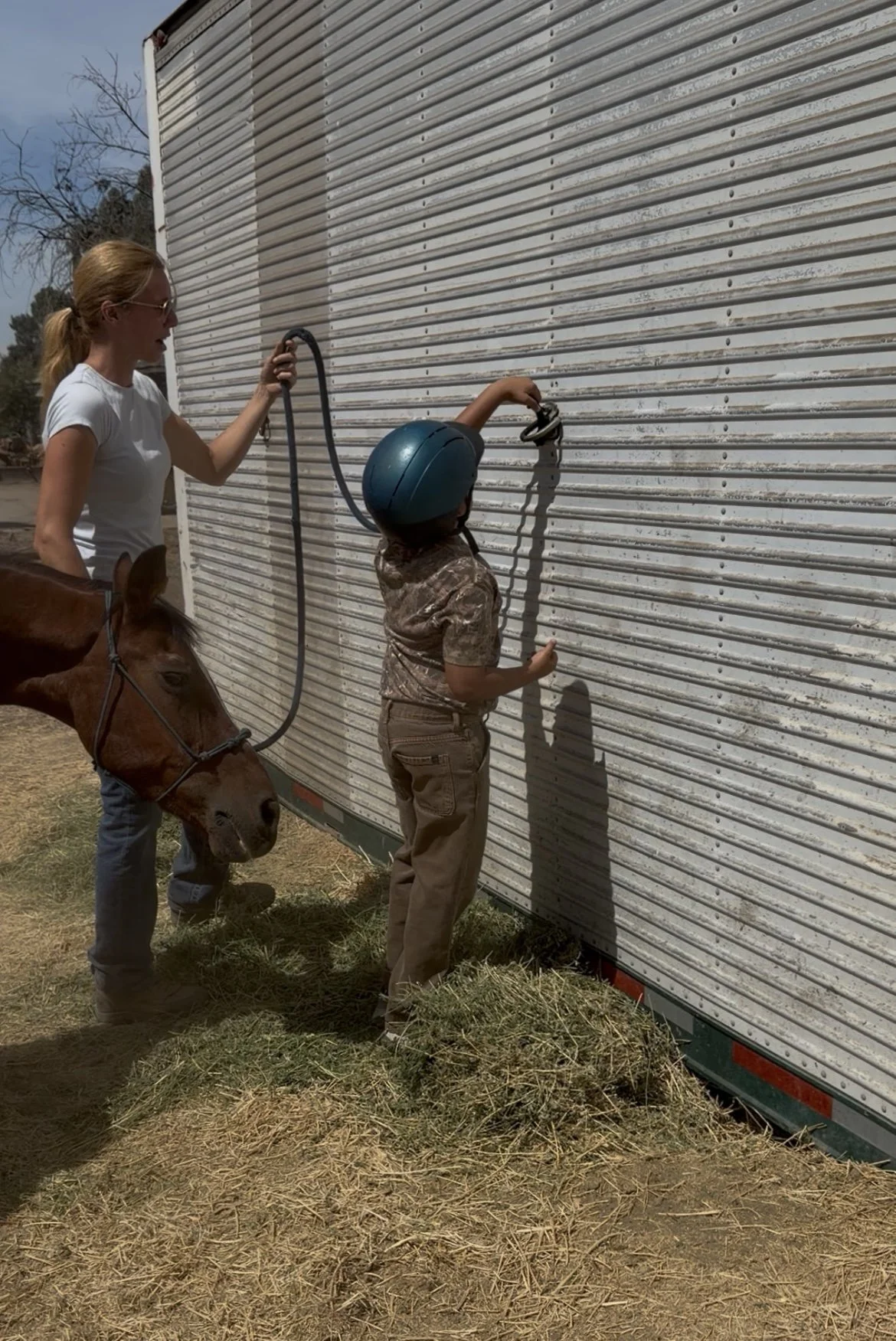
We encourage participants to take an active role in their sessions. Rather than immediately completing a task for them, we provide appropriate support and give them time to explore and try.
Independence does not always mean doing something alone. It can also mean having the confidence to make a choice, express a need, or ask for assistance.
Every milestone deserves to be celebrated.
A Place to Belong
Everyone deserves a hobby, something to look forward to, and a place where they feel included.
At Equiroots, participants become part of an authentic equestrian environment. They experience everyday ranch life, interact with horses, spend time outdoors, and explore their own interests within the community.
For some, it becomes a favorite weekly activity. For others, it is an opportunity to discover a new passion.
Personal development is an important part of our program, but so are enjoyment, friendship, connection, and simply having fun.
Where Psychology Meets Horsemanship
With a background in applied psychology, the founder of Equiroots brings an understanding of human behavior, learning, motivation, and individual development into the equestrian environment.
Our approach combines this knowledge with practical horsemanship to create individualized, strengths-based experiences.
We believe in providing enough structure to support learning, enough flexibility to respect individual needs, and enough encouragement to help participants discover their own abilities.
Our Adaptive Riding Program is recreational and educational in nature and is not a substitute for clinical therapy or medical treatment.
Getting Started at Equiroots
Our program welcomes children ages four and older, teenagers, and adults. No previous horse experience is required.
Every participant begins with an introductory session, where we get to know their interests, abilities, communication preferences, and support needs.
We introduce the horses and explore which activities are appropriate and safe. There is no expectation that a participant must ride during their first visit.
Families, caregivers, and support professionals are welcome to share information that helps us create a positive and meaningful experience.
Regional Center & Self-Determination Program Funding
Equiroots works with families, service coordinators, and Financial Management Services (FMS) providers to support access to adaptive riding through California's Self-Determination Program (SDP), where individual funding and service authorization are available.
We also welcome inquiries from Valley Mountain Regional Center (VMRC) service coordinators, independent facilitators, and professionals seeking individualized, community-based recreational opportunities.
Please contact us to discuss your individual funding arrangements.
Discover What Is Possible
Whether you are looking for an inclusive activity for your child, a meaningful hobby for yourself, or opportunities to practice everyday life skills, we would love to welcome you to Equiroots.
You don't need to know exactly what your journey with horses will look like.
That's something we can discover together.
Different abilities. Individual journeys. Meaningful connections.
Equiroots — Connected Through Horses.
Located at Cavallo Riding Center in Tracy, California, serving Tracy, Mountain House, Manteca, Lathrop, Stockton, Livermore, and surrounding communities.
Book your Adaptive Riding Introduction
www.equiroots.com
(209) 305-5848

Horse Therapy and Equine-Assisted Learning: What Horses Can Show Us.
Looking for horse therapy in tracy, CA? At EquiRoots, I use Equine-Assisted Learning (EAL) to explore confidence, communication and self-awareness through real interactions with horses - grounded in psychology, horse behavior and neuroscience.
There are moments with horses that stay with you. Sometimes you understand immediately what happened. Sometimes a horse responds in a way that makes you stop and wonder:
What did that horse just notice?
I’ve been fascinated by that question for a very long time.
Long before I knew there was such a thing as Equine-Assisted Learning.
I think horses started teaching me when I was a teenager
I remember arriving late at the barn one day as a teenager. I was frustrated, in a hurry and just wanted to get my horse and go. Except he wouldn’t come with me.
The more frustrated I became, the less interested he seemed in following. I kept trying until eventually the rope broke and I ended up sitting in a mud puddle.
I was angry, covered in mud and definitely not thinking about it as some profound life lesson.
But I remember realizing that maybe my horse wasn’t the problem.
I had walked up to him frustrated and rushed, expecting him to simply follow me. I wasn’t paying attention to him at all or to what I was bringing into the interaction.
That moment stayed with me. And over the years, I’ve had countless moments with horses that brought me back to the same thing.
They notice us.
Our body language. Our movement. Our attention. Our tension. How clearly we communicate. Whether we’re actually present with them.
And sometimes, they seem to notice things we haven’t noticed at all.
Then I found the neuroscience behind it
This is one of the reasons I became so interested in the work of Janet L. Jones, PhD, a neuroscientist, horsewoman and author of Horse Brain, Human Brain: The Neuroscience of Horsemanship.
For me, her work put neuroscience behind something I had already been fascinated by and experiencing around horses for years.
Jones explores how differently equine and human brains perceive, focus, learn and communicate.
Horses evolved as prey animals. Their survival has depended on paying very close attention to their environment and noticing changes around them.
Humans are different. We can physically be standing beside a horse while mentally being somewhere else entirely.
Thinking about yesterday.
Worrying about tomorrow.
Wondering whether we’re doing something right.
Or, in my case as a teenager, being so frustrated about being late that I wasn’t really paying attention to my horse at all.
The more I learn about the horse brain, the more fascinating those interactions become to me.
It doesn’t take away the magic.
If anything, it makes me wonder how much horses are noticing that we don’t.
Horses don’t need our words
This becomes especially interesting during Equine-Assisted Learning (EAL).
Humans rely heavily on language. We explain ourselves. We rationalize. We can say we’re confident while our body shows hesitation. We can say we’re fine while we’re tense from head to toe.
A horse doesn’t know that story.
They have the person standing in front of them.
During an EAL session, I might ask someone to create space between themselves and a horse.
They can know exactly what they want the horse to do, but their body might be communicating something completely different.
Maybe they ask the horse to move while stepping backwards themselves. Maybe they hesitate. Maybe the horse doesn’t respond and they immediately look at me to solve it for them. Or they become frustrated and start trying harder and harder.
That’s where it becomes interesting.
Because instead of sitting somewhere talking about confidence, boundaries or communication, suddenly we can see and experience it happening.
What changed?
What did you do?
What did the horse do?
What happens if you try it differently?
That’s the part I love.
Sometimes horses notice things we don’t
And then there are moments I can’t explain as easily.
I once watched a horse become unusually interested in a woman’s stomach.
She kept returning to the same place and smelling her belly.
Again.
And again.
It was noticeable enough that I finally mentioned it.
The woman looked at me and said:
“I’m pregnant.”
That moment stayed with me.
What exactly was the horse noticing?
Scent is an important part of how horses perceive their world. Research has even shown that horses can distinguish between human body odors collected in different emotional contexts, including fear and joy.
So I don’t think we should underestimate how much information horses may be receiving from us simply because we can’t perceive it.
Did that horse know she was pregnant?
I can’t answer that.
But she noticed something.
And sometimes I’m perfectly happy to leave a little mystery around moments like that.
And then there was Sadie
One of my favorite examples happened during an Equine-Assisted Learning session with Sadie.
The woman I was working with came in with a lot of energy. She talked almost constantly. Even during exercises, slowing down and simply being quiet was difficult for her.
At one point, I asked her to stand beside Sadie and place both hands on Sadie’s belly.
That was it. No talking, nothing she had to accomplish.
Just stand there. Breathe. Feel the horse underneath her hands.
Slowly, she became quiet.
Really quiet.
And Sadie started to relax.
Her body softened. She became sleepy.
And eventually she became so relaxed that she actually went down to the ground. I had never seen Sadie do that during one of my sessions before.
A few minutes earlier, I had been standing with someone who could barely stop talking. Now she was completely still beside a horse relaxed enough to lie down.
It was beautiful to watch.
Could I tell you exactly what happened between them?
No.
But something had shifted.
And she could feel it too.
Sometimes the horse creates the moment
That’s when the learning starts.
I don’t have to tell someone what Sadie was thinking.
I can ask:
What did you notice?
What happened when you finally became quiet?
What could you feel underneath your hands?
When did you notice Sadie beginning to relax?
What changed in yourself?
Those questions are much more interesting to me than deciding exactly what every movement from the horse “means”.
And that’s an important part of how I approach EAL. I don’t believe the horse is there to diagnose someone.
But I also don’t believe we need to explain away every unusual or beautiful interaction.
Sometimes the horse creates a moment I never could have planned.
And suddenly we have something real to work with.
That’s what makes Equine-Assisted Learning different
We can talk about boundaries… Or you can experience what it feels like to ask a 1,000-pound animal to respect your space.
We can talk about confidence… Or we can see what happens when a horse doesn’t immediately do what you ask.
We can talk about overthinking… Or I can give you an exercise without telling you exactly how to solve it.
We can talk about being present… Or you can stand quietly beside a horse and discover that truly being quiet for a few minutes is much harder than it sounds.
You’re not only talking about yourself. You’re experiencing yourself in interaction with another living being.
And that horse responds. Sometimes in ways that are easy to understand. Sometimes in ways that surprise us. And sometimes in ways that leave us with more questions than answers.
Is Equine-Assisted Learning the same as horse therapy?
People searching for horse therapy in Tracy, California will find terms like horse therapy, equine therapy, equine-assisted therapy and Equine-Assisted Learning used in many different ways.
At EquiRoots, what I offer is Equine-Assisted Learning rather than psychotherapy.
My background in Applied Psychology influences how I structure sessions, observe behavior and ask questions, but EAL is experiential.
We can work on confidence, communication, boundaries, self-awareness, problem-solving and being more present.
You don’t need any experience with horses. And you don’t need to come in knowing exactly what you want to work on. Sometimes we start with the horse and see what happens.
Maybe that’s part of the magic
I don’t think we have to choose between understanding the science and appreciating that there is something special about interacting with horses.
Actually, the more I learn about the horse brain, the more fascinating horses become to me. Janet Jones’ work helps me understand the animal standing in front of me.
Research continues to teach us more about what horses can see, smell, perceive and respond to and then I still have moments where a horse repeatedly smells the belly of a woman who tells me she’s pregnant.
Or Sadie lies down beside someone who, minutes earlier, couldn’t seem to become still.
Or I think back to teenage me sitting in that mud puddle because my horse absolutely refused to come along with my frustrated plans.
Some things I understand much better now. Others still make me wonder. And maybe that’s part of what makes working with horses so special.
They make us pay attention.
To them.
To what’s happening in the moment.
And very often, to ourselves.
Sources & Further Reading
Jones, Janet L., PhD. (2020). Horse Brain, Human Brain: The Neuroscience of Horsemanship. Trafalgar Square Books.
Jones is a neuroscientist and horsewoman whose work brings together neuroscience and horsemanship, exploring differences between equine and human perception, attention, learning and communication.
Jardat, P., Destrez, A., Damon, F., et al. (2023). “Horses discriminate human body odors between fear and joy contexts in a habituation-discrimination protocol.” Scientific Reports, 13, 3285.
The study found that horses could discriminate between human body odors collected in fear and joy contexts.