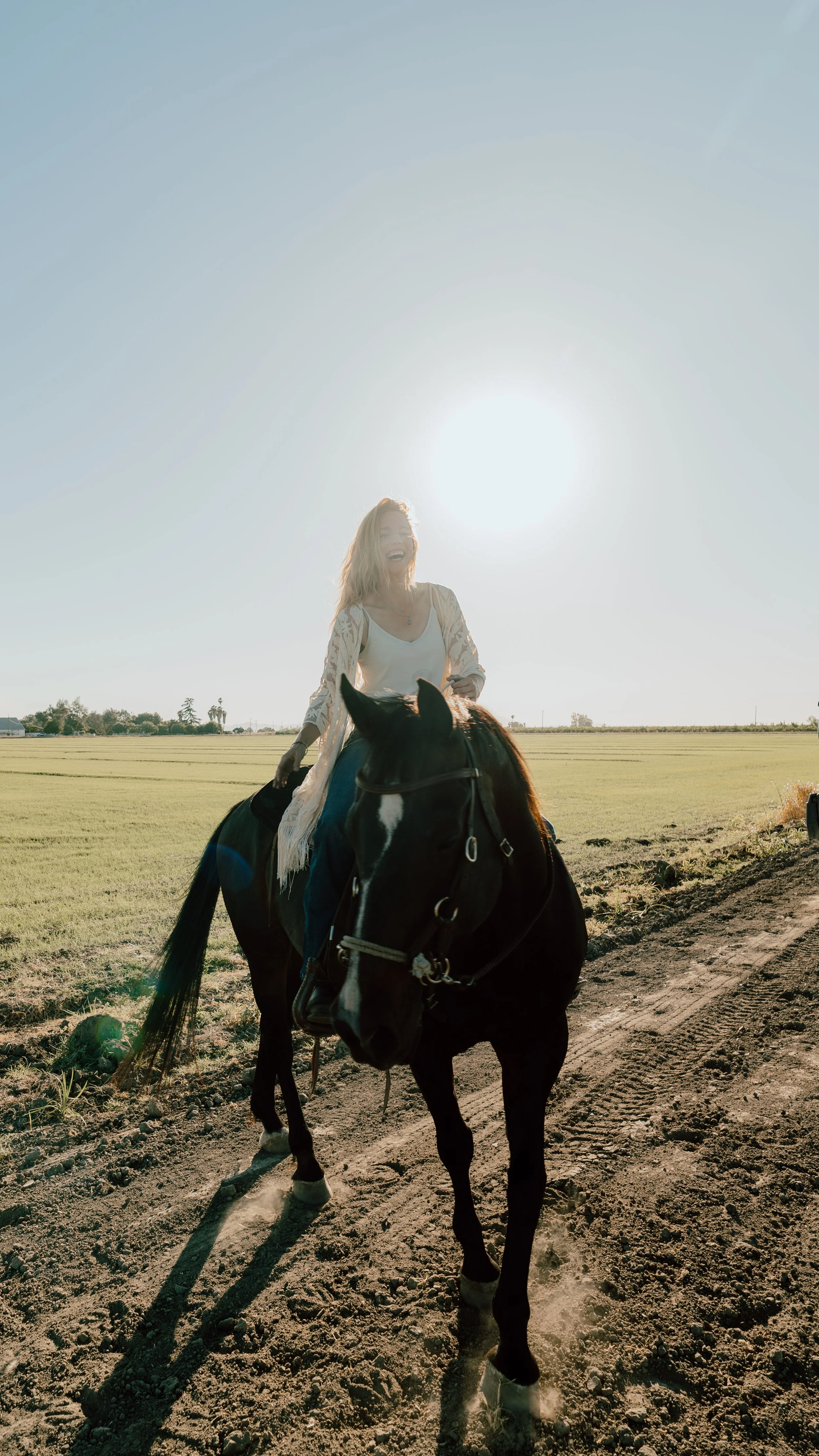
Horseback Riding for Nervous Beginners: Building Confidence Through Connection
Nervous around horses or new to riding? Discover how a slower, more mindful approach can help you build confidence, understand the horse and create a real connection before and during your ride.
For many people, learning to ride starts with getting on a horse.
At EquiRoots, I often start somewhere else.
Before learning how to ride, I want you to get to know the horse in front of you. To observe, communicate, and understand a little more about the animal you're about to trust. Especially when you're nervous, that can make all the difference.
What if being close to a horse already feels scary?
Recently, I worked with someone who became nervous simply standing close to the horse. So getting into the saddle wasn't our first goal. We started by observing the horse from a little distance. What was she doing? Where was her attention? Did she look relaxed?
When that felt okay, we moved closer. Then came the first touch. After that, some gentle grooming. Eventually, they walked together.
Throughout the process, we kept coming back to something simple: breathing. Slowing the breath down. Relaxing the shoulders. Noticing when tension started building instead of trying to ignore it.
There was no pressure to ride.
But step by step, something changed. Being close to the horse didn't feel quite as overwhelming anymore. There was more understanding, more trust, and more calm. Eventually, she decided she was ready and she rode.
For me, the important part wasn't that she got on a horse during her first session. It was how she got there. She didn't have to push past her fear or pretend it wasn't there. We gave her the time to feel comfortable with the horse first. Confidence came from understanding.
Learn the horse before you ride the horse
Every horse is different. Some are curious. Some are sensitive. Some need more encouragement, while others seem to know exactly what they're doing. That's why I don't want riders to see a horse as something they simply get on and control.
I want you to learn the horse.
Before riding, we may spend time grooming, leading, observing, or doing groundwork. You'll start noticing body language and learning how a horse responds to your position, movement, pressure, and intention.
What happens when you rush?
What happens when you slow down?
When is the horse paying attention to you?
Can you ask for something quietly instead of immediately using more pressure?
The more you understand on the ground, the more riding starts to make sense in the saddle.
That's horsemanship; and to me, it's an important part of learning to ride.
A more mindful way to learn horseback riding
My background in Applied Psychology naturally influences the way I teach. I don't only pay attention to what the horse is doing. I'm also interested in what is happening with the person.
Breathing. Body awareness. Focus. Confidence. Tension.
Horses give us an interesting opportunity to become more aware of all of those things. Sometimes I'll ask a rider to stop worrying about whether everything looks perfect and instead notice what they can feel:
Can you feel the rhythm of the horse's walk underneath you?
Can you notice when your body becomes tense?
What happens when you breathe out, soften your body, and become more present?
This can be especially helpful for nervous beginners, but it's valuable for experienced riders too.
Riding isn't only about giving the right cues.
It's communication.
Yes, you'll still learn how to ride
Connection doesn't replace riding skills.
You'll still learn balance, steering, transitions, leg cues, trot and canter when you're ready, obstacles, and other practical riding skills. But I want you to understand why you're doing something instead of simply following instructions.
A horse isn't a bicycle. You're working with another living being who is constantly communicating with you. And when you begin to understand that communication, riding starts to feel different. Less like controlling a horse. More like working together.
Horseback riding lessons in Tracy, California
EquiRoots offers private horseback riding and horsemanship lessons in Tracy, CA for kids, teens, and adults. I especially welcome complete beginners, returning riders, and people who feel nervous or less confident around horses.
You don't have to arrive confident. And you don't have to prove anything by getting into the saddle as quickly as possible. We'll start where you are, get to know the horse in front of you, and build from there.
Because at EquiRoots, you don't just learn how to ride a horse.
You learn how to understand one.

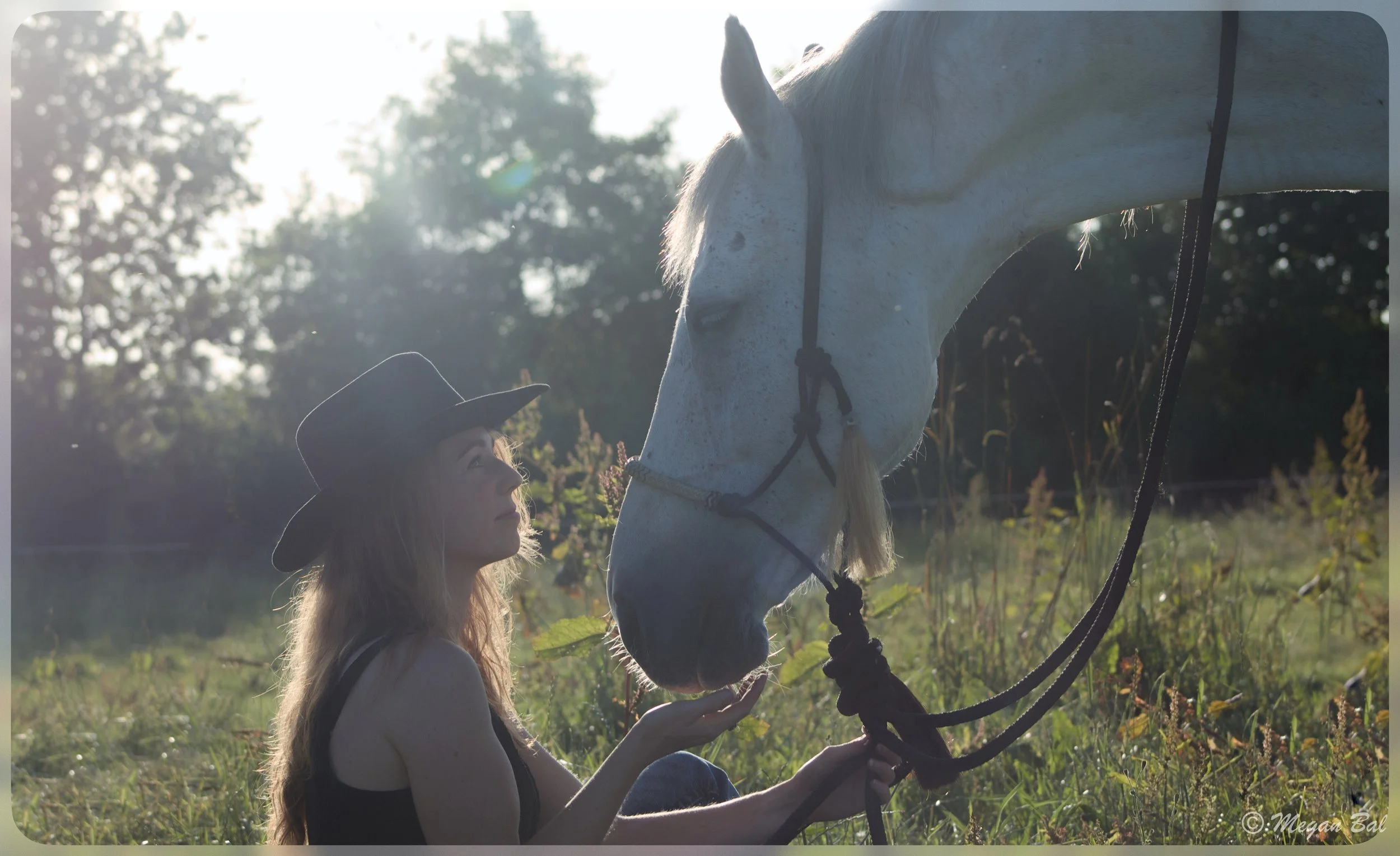
Horse Therapy and Equine-Assisted Learning: What Horses Can Show Us.
Looking for horse therapy in tracy, CA? At EquiRoots, I use Equine-Assisted Learning (EAL) to explore confidence, communication and self-awareness through real interactions with horses - grounded in psychology, horse behavior and neuroscience.
There are moments with horses that stay with you. Sometimes you understand immediately what happened. Sometimes a horse responds in a way that makes you stop and wonder:
What did that horse just notice?
I’ve been fascinated by that question for a very long time.
Long before I knew there was such a thing as Equine-Assisted Learning.
I think horses started teaching me when I was a teenager
I remember arriving late at the barn one day as a teenager. I was frustrated, in a hurry and just wanted to get my horse and go. Except he wouldn’t come with me.
The more frustrated I became, the less interested he seemed in following. I kept trying until eventually the rope broke and I ended up sitting in a mud puddle.
I was angry, covered in mud and definitely not thinking about it as some profound life lesson.
But I remember realizing that maybe my horse wasn’t the problem.
I had walked up to him frustrated and rushed, expecting him to simply follow me. I wasn’t paying attention to him at all or to what I was bringing into the interaction.
That moment stayed with me. And over the years, I’ve had countless moments with horses that brought me back to the same thing.
They notice us.
Our body language. Our movement. Our attention. Our tension. How clearly we communicate. Whether we’re actually present with them.
And sometimes, they seem to notice things we haven’t noticed at all.
Then I found the neuroscience behind it
This is one of the reasons I became so interested in the work of Janet L. Jones, PhD, a neuroscientist, horsewoman and author of Horse Brain, Human Brain: The Neuroscience of Horsemanship.
For me, her work put neuroscience behind something I had already been fascinated by and experiencing around horses for years.
Jones explores how differently equine and human brains perceive, focus, learn and communicate.
Horses evolved as prey animals. Their survival has depended on paying very close attention to their environment and noticing changes around them.
Humans are different. We can physically be standing beside a horse while mentally being somewhere else entirely.
Thinking about yesterday.
Worrying about tomorrow.
Wondering whether we’re doing something right.
Or, in my case as a teenager, being so frustrated about being late that I wasn’t really paying attention to my horse at all.
The more I learn about the horse brain, the more fascinating those interactions become to me.
It doesn’t take away the magic.
If anything, it makes me wonder how much horses are noticing that we don’t.
Horses don’t need our words
This becomes especially interesting during Equine-Assisted Learning (EAL).
Humans rely heavily on language. We explain ourselves. We rationalize. We can say we’re confident while our body shows hesitation. We can say we’re fine while we’re tense from head to toe.
A horse doesn’t know that story.
They have the person standing in front of them.
During an EAL session, I might ask someone to create space between themselves and a horse.
They can know exactly what they want the horse to do, but their body might be communicating something completely different.
Maybe they ask the horse to move while stepping backwards themselves. Maybe they hesitate. Maybe the horse doesn’t respond and they immediately look at me to solve it for them. Or they become frustrated and start trying harder and harder.
That’s where it becomes interesting.
Because instead of sitting somewhere talking about confidence, boundaries or communication, suddenly we can see and experience it happening.
What changed?
What did you do?
What did the horse do?
What happens if you try it differently?
That’s the part I love.
Sometimes horses notice things we don’t
And then there are moments I can’t explain as easily.
I once watched a horse become unusually interested in a woman’s stomach.
She kept returning to the same place and smelling her belly.
Again.
And again.
It was noticeable enough that I finally mentioned it.
The woman looked at me and said:
“I’m pregnant.”
That moment stayed with me.
What exactly was the horse noticing?
Scent is an important part of how horses perceive their world. Research has even shown that horses can distinguish between human body odors collected in different emotional contexts, including fear and joy.
So I don’t think we should underestimate how much information horses may be receiving from us simply because we can’t perceive it.
Did that horse know she was pregnant?
I can’t answer that.
But she noticed something.
And sometimes I’m perfectly happy to leave a little mystery around moments like that.
And then there was Sadie
One of my favorite examples happened during an Equine-Assisted Learning session with Sadie.
The woman I was working with came in with a lot of energy. She talked almost constantly. Even during exercises, slowing down and simply being quiet was difficult for her.
At one point, I asked her to stand beside Sadie and place both hands on Sadie’s belly.
That was it. No talking, nothing she had to accomplish.
Just stand there. Breathe. Feel the horse underneath her hands.
Slowly, she became quiet.
Really quiet.
And Sadie started to relax.
Her body softened. She became sleepy.
And eventually she became so relaxed that she actually went down to the ground. I had never seen Sadie do that during one of my sessions before.
A few minutes earlier, I had been standing with someone who could barely stop talking. Now she was completely still beside a horse relaxed enough to lie down.
It was beautiful to watch.
Could I tell you exactly what happened between them?
No.
But something had shifted.
And she could feel it too.
Sometimes the horse creates the moment
That’s when the learning starts.
I don’t have to tell someone what Sadie was thinking.
I can ask:
What did you notice?
What happened when you finally became quiet?
What could you feel underneath your hands?
When did you notice Sadie beginning to relax?
What changed in yourself?
Those questions are much more interesting to me than deciding exactly what every movement from the horse “means”.
And that’s an important part of how I approach EAL. I don’t believe the horse is there to diagnose someone.
But I also don’t believe we need to explain away every unusual or beautiful interaction.
Sometimes the horse creates a moment I never could have planned.
And suddenly we have something real to work with.
That’s what makes Equine-Assisted Learning different
We can talk about boundaries… Or you can experience what it feels like to ask a 1,000-pound animal to respect your space.
We can talk about confidence… Or we can see what happens when a horse doesn’t immediately do what you ask.
We can talk about overthinking… Or I can give you an exercise without telling you exactly how to solve it.
We can talk about being present… Or you can stand quietly beside a horse and discover that truly being quiet for a few minutes is much harder than it sounds.
You’re not only talking about yourself. You’re experiencing yourself in interaction with another living being.
And that horse responds. Sometimes in ways that are easy to understand. Sometimes in ways that surprise us. And sometimes in ways that leave us with more questions than answers.
Is Equine-Assisted Learning the same as horse therapy?
People searching for horse therapy in Tracy, California will find terms like horse therapy, equine therapy, equine-assisted therapy and Equine-Assisted Learning used in many different ways.
At EquiRoots, what I offer is Equine-Assisted Learning rather than psychotherapy.
My background in Applied Psychology influences how I structure sessions, observe behavior and ask questions, but EAL is experiential.
We can work on confidence, communication, boundaries, self-awareness, problem-solving and being more present.
You don’t need any experience with horses. And you don’t need to come in knowing exactly what you want to work on. Sometimes we start with the horse and see what happens.
Maybe that’s part of the magic
I don’t think we have to choose between understanding the science and appreciating that there is something special about interacting with horses.
Actually, the more I learn about the horse brain, the more fascinating horses become to me. Janet Jones’ work helps me understand the animal standing in front of me.
Research continues to teach us more about what horses can see, smell, perceive and respond to and then I still have moments where a horse repeatedly smells the belly of a woman who tells me she’s pregnant.
Or Sadie lies down beside someone who, minutes earlier, couldn’t seem to become still.
Or I think back to teenage me sitting in that mud puddle because my horse absolutely refused to come along with my frustrated plans.
Some things I understand much better now. Others still make me wonder. And maybe that’s part of what makes working with horses so special.
They make us pay attention.
To them.
To what’s happening in the moment.
And very often, to ourselves.
Sources & Further Reading
Jones, Janet L., PhD. (2020). Horse Brain, Human Brain: The Neuroscience of Horsemanship. Trafalgar Square Books.
Jones is a neuroscientist and horsewoman whose work brings together neuroscience and horsemanship, exploring differences between equine and human perception, attention, learning and communication.
Jardat, P., Destrez, A., Damon, F., et al. (2023). “Horses discriminate human body odors between fear and joy contexts in a habituation-discrimination protocol.” Scientific Reports, 13, 3285.
The study found that horses could discriminate between human body odors collected in fear and joy contexts.